
In my day job I work for an exam board and coordinate practical drama exams (my life is surrounded by DRAMA!) and I recently attended a training day for our examiners, it became clear that analysing performance is actually impossible, unlike other performance exams such a music it feels utterly subjective, even guidance seems impossible to decipher, especially in the brief time examiners have to analyse a performance. It made me wonder; how exactly does a critic judge a good performance.
As someone who writes and reviews I wish there was a guide book for critics, detailing what requirements a play must have to get 5 stars because I highly suspect they just make it up as they go along. It doesn’t help that there seems to be a lot of love for large theatres with star names and very little time or tolerance for smaller theatres above pubs.
My suggestion is a marks system-which I have stolen from one of my job’s exams!
A production is rated out of 100 on;
- Group dynamic
- Individual performances
- Staging
- Design (including set, props and costume)
- Technical (including lighting and sound)
It makes far more sense for a critic analyse all these important elements separately rather than be blinded by the star name, the incredible set or how good the interval ice cream was, I would ideally include this in all reviews. Video game reviews use a similar out of 100 rating system and it is pretty clear that anything under 60 is probably not worth someone’s time but it has its flaws. What do I know about technical or design beyond “The lighting was good, I could see the set” or “the set was pretty”. It could be argued “What do I know about a good play!”
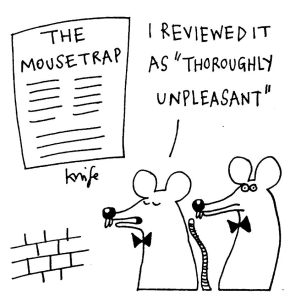
I am not suggesting we remove all reviews but there needs to be a consistency, too many reviews which seem like 2 stars at best are then given 5 star reviews. I know there is probably some politics I am not privy too but it is alienating theatre goers, confused by why they’ve just paid £50+ to see something utterly dreadful, muttering “but Michael Billington said it was good” as they leave the theatre.

 View from the Cheap Seat
Leave a comment